Wayne's Own Speaker System
Updated 09/18/2002
Well, I probably should tell what my system consists of. Because I'm a musician and know what instruments sound like, I really wanted my living room system to more or less duplicate what I was used to hearing with real instruments. Huh, big talk--who doesn't?
One difference with my approach is that I also have a rack of sound processing equipment, including a guitar amplifier simulator and electronic drums, and routinely plug real live guitars into the rack. I know how these live guitars sound when amplified using regular guitar amps. Acoustic guitars also, for that Michael Hedges sound. I also have played real drums in a band, and I am familiar with what they sound like too.
Maintaining any semblance of live dynamics tends to totally swamp out conventional home hi-fi speakers. That's why I moved to an electronic crossover approach. Also, why I'm on speaking terms with pro-sound equipment.
My living room system is essentially a PA system. However....
I really spend most of my time listening to CDs through this system. It's just that I keep comparing the sound to live music--well, because its there. (And I can haul out the guitar amps and drums, if I forget.)
With that out of the way, the other main criteria for my system was to build it a piece at a time, with no one piece costing much more than $300, or so.
Also note: I have substituted a lot of different drivers and boxes into my system. The following is what I am currently using. Tomorrow, it might be something completely different. Or more likely, one component will be swapped for another.
- Midrange and tweeter. 450 Hz--2.5 Khz The above mentioned Audax PR170X0 midrange driver, of course. 101 db sensitivity. Guitar sounds to die for! Vocals too. Would you like tube guitar amp distortion reproduced just the way it sounds like in real life? Undistorted stuff, too. Installed in a autosound box I got from Parts Express using Acoustic Stuff "stuffing" and a Deflex panel I got from Madisound. No grill. They don't look too bad. And look somewhat like the "egg" enclosures used by the
Waveform Mach 17.
I'm using a Vifa H26TG35-06 horn tweeter. I'm currently using a passive crossover that Madisound designed and built. (You can see it on the top of the box--I never mounted the crossover inside the box.) Using a passive crossover brings me down to a three way system. I was running 4 way (no passive crossover), but decided that the extra head room wasn't worth the complication of another crossover and power amp. YMMV.
2010-01-19 Note: the PR170X0 is no longer available. But Audax has drivers that serve the same purpose. See the Audax section of Madisound's on-line catalog and look for the "Audax Professional Midrange." They cover the same frequency range and still have the all-important approx. 99db efficiency. Vifa has at least one horn dome tweeter that has a sensitivity of 96 db. So you should be good to go.
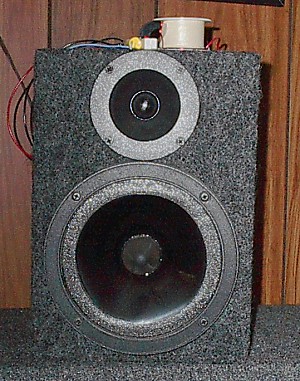
- Mid bass. 80 Hz -- 450 Hz. Currently are 10" Madisound 10" poly woofers in an 1.5 cu. foot autosound boxes. These could be a half decent subs if they were stuck in a corner, but aren't good for much below 80 Hz when positioned directly under the 6 1/2" drivers, as is needed to get any kind of coherency when crossing over at 450 Hz. I'm not giving the model number because I checked Madisound's web site and this particular model isn't available anymore. This is easy to design anyway--get a decent 10" driver and put it in a 1 - 1 1/2 cu. ft. sealed box. Throw in some acoustic stuffing material.
Not too pretty and will eventually be replaced with decent looking enclosures. Someday.
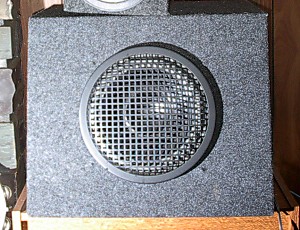
- Sub woofers. 80 Hz and down. I'm using one Madisound "Infrabass" sub enclosure that contains two 10" Peerless 1729 CC line drivers. About 3 cu. foot. I'm not showing this because this also isn't available on Madisound's site anymore. And I have to confess that I am currently using one Radio Shack's 12" passive subwoofer. I had it laying around and the system sounds better with it than without it. Dualing standing waves, or something.
- Power Amplifiers. A 3-way electronically crossed over system tends to use a lot of amps. 3 stereo amps, exactly. I started out using several receivers that I had collected, and an old Dynaco Stereo 150 power amp. I'm currently using three Radio Shack 100 watt/channel PA amps. These are attractive for us beer budget guys, because they are cheap ($300 normally, $200 when on sale), well built, have really neat LARGE lighted power meters (handy when setting levels), and have speaker switching, which is valuable when you are, say, trying to judge between two different sets of tweeters. Also, they have power-on muting, which is very valuable when you are driving tweeters directly with no other protection. 100 watts/ch. is a bit light for the subs and I'll eventually upgrade to more powerful amps.
- The RS amp's large bright green lighted VU meters sort of lost their attractiveness in the living room, and the amps moved to be behind my rack. They are now sitting on top of the RS subwoofer, and the weight stiffens up the box a little, and serves to couple it to the floor better.
- Crossover--Carvin XC 3000 3 way 24 db/octave for the mid/tweeters, mid bass, and subs.
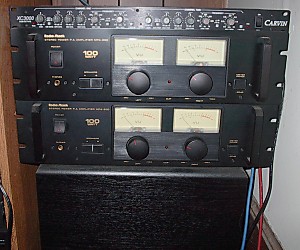
Two RS power amps and Carvin crossover
Sitting on top of RS sub
- Preamp. Mackie 1201 VLZ Pro mixer. For plugging in guitar preamps, keyboards, mikes, CD player, etc. Very handy and highly reccomended.
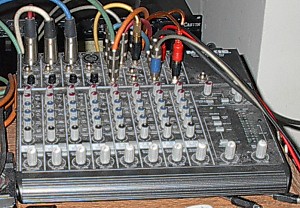
- Interconnects. Radio Shack's finest. For line level, I use the black ones with the golden ends, supplemented with some cables that I made using cable and plugs that I got from Conquest. I use a lot of cables. Speaker cable is also Radio Shack's finest 16 gauge "speaker cable" (as opposed to zip cord). I never splurged for their "Magna" cable.
I originally used my Liberty Instruments Audio Suite to set levels and to check for proper phase and frequency response, but I found, after a while, that the settings that I dialed in by ear also measured the best, so I haven't used the Audio Suite in a while. But it is really handy to have it for the times when you are driving yourself batty trying to dial in that last bit of realism. Sometimes an objective viewpoint is helpful. (However, if I hadn't done all those measurements, I wouldn't be so sanguine about the sound.)
In other words, a work in progress.
Wayne Larmon can be reached at wlarmon@scrounge.org
Back to Wayne's Speaker Building Page